While the Ultra model often dominates the headlines, the standard Samsung Galaxy S26 emerges as a highly practical compact flagship. Designed for users who want top-tier performance without a bulky footprint, it introduces key improvements in display quality, processing, and camera software at a more accessible price point.
Sleeker Build and Brighter Display
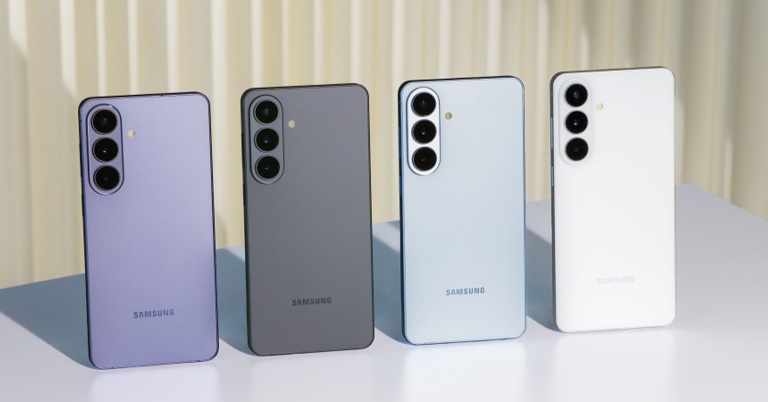
The Galaxy S26 measures 149.6 × 71.7 × 7.2mm and weighs 167 grams—adding just 5 grams over last year's S25 despite packing a larger screen and battery. The phone incorporates an Armor Aluminum 2 frame, Gorilla Glass Victus 2 protection, and IP68 water and dust resistance. Its updated aesthetic includes softer corners, flatter sides, and a translucent "Ambient Island" camera module that unifies the rear lenses. Color options include Cobalt Violet, Sky Blue, Black, and White, alongside Samsung.com exclusives Silver Shadow and Pink Gold.
The front is dominated by an upgraded 6.3-inch Dynamic LTPO AMOLED 2X display featuring an adaptive 1–120Hz refresh rate and a peak brightness of 2,600 nits. While retaining an FHD+ resolution (1080 × 2340), image clarity is boosted by a new mDNIe image processor (four times more precise than the S25's) and Ultra-level ProScaler AI upscaling.
Hardware, Performance, and Battery
Depending on the market, the Galaxy S26 features different chipsets. In the US and China, it runs on the Snapdragon 8 Elite Gen 5 for Galaxy, which boasts up to 19% faster CPU performance, 24% stronger GPU output, and 39% faster AI processing. Other regions receive Samsung's 2nm Exynos 2600 processor. Heat management sees a notable upgrade, offering up to 29% better heat dissipation than its predecessor. Samsung has also phased out the 128GB storage tier; all variants now start at 256GB storage paired with 12GB of LPDDR5X RAM. Powering the device is an enlarged 4,300mAh battery, up from the 4,000mAh capacity found on the S25.
Refined AI Cameras and Video
The rear triple-camera array maintains familiar hardware specs: a 50MP f/1.8 primary sensor, a 12MP ultrawide lens, and a 10MP telephoto camera with 3x optical zoom, complemented by a 12MP front camera. However, software enhancements provide substantial image quality improvements. Nightography Video now uses per-sensor noise reduction for clearer low-light clips, while Horizontal Lock delivers advanced horizon stabilization. Advanced AI ISP tuning produces more natural colors, and creative suites like Photo Assist and Creative Studio allow seamless photo editing. Video recording capabilities reach up to 8K at 30fps and 4K at 60fps with 10-bit HDR support.