Apple officially expanded its flagship laptop lineup on March 11 with the announcement of the 14-inch MacBook Pro featuring the next-generation M5 Pro and M5 Max chips. However, due to an ongoing global memory shortage, buyers looking to purchase the new MacBook Pro in Nepal should expect a price hike compared to previous models.
Familiar Design with an Anti-Glare Display Option
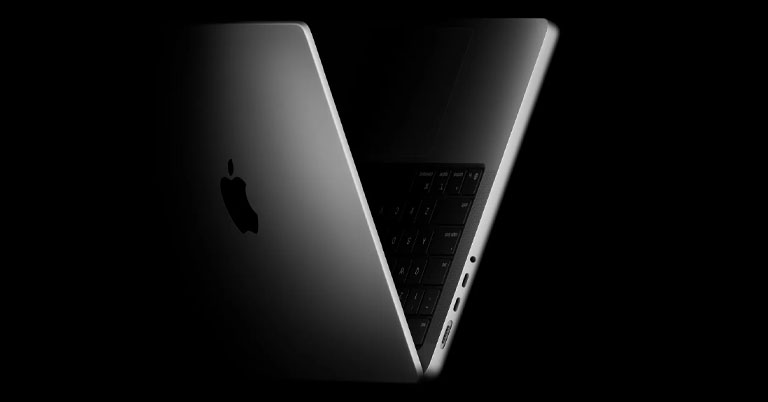
The external design remains unchanged from the previous iteration. It sports the same aluminum chassis available in Space Black and Silver, measuring 0.61 inches in thickness. The M5 Pro configuration weighs around 3.4 pounds, whereas the M5 Max variant is slightly heavier to accommodate its additional cooling demands. Since the dimensions are identical, existing sleeves and cases designed for the M4 model will fit perfectly. Inputs remain top-tier with a backlit Magic Keyboard, Touch ID, and a Force Touch trackpad.
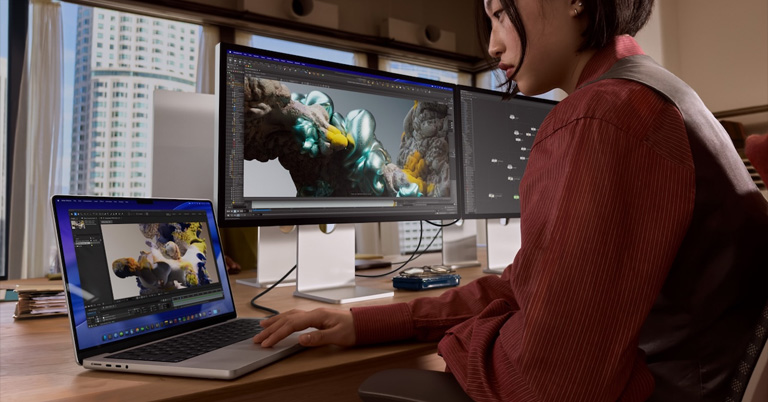
The 14.2-inch Liquid Retina XDR display retains its key specifications: a 3024 x 1964 resolution, 120Hz ProMotion refresh rate, 1,000,000:1 contrast ratio, 1000 nits SDR brightness, 1600 nits peak HDR brightness, and P3 wide color. The big display addition this year is an optional nano-texture glass configuration, which minimizes glare and reflections in bright environments without reducing image sharpness or color accuracy. Furthermore, the M5 Pro variant can handle up to three external displays at once, while the M5 Max supports up to four.
M5 Pro & M5 Max: Fusion Architecture & AI Gains
Both new processors are built on Apple's Fusion Architecture, combining two dies into a single SoC. They pack an 18-core CPU featuring 6 super cores and 12 performance cores, yielding up to a 30% jump in multi-threaded CPU performance compared to the M4 Pro and M4 Max. For artificial intelligence tasks, the GPU includes dedicated Neural Accelerators per core, delivering up to 4x faster LLM prompt processing over M4 Pro/Max and up to 8x faster processing over the M1 Pro/Max chips.
Graphics performance sees an upgrade of up to 50% over the M4 series. Real-world gains reported by Apple include 1.4x faster 3D rendering in Redshift compared to M4 Pro, up to 3x faster video effects rendering in DaVinci Resolve on M5 Max, 3.5x faster AI video processing in Topaz Video, and 1.6x faster ray tracing performance in games like Cyberpunk 2077 over M4 Pro.
Expanded Memory, Faster SSD, and Thunderbolt 5
Unified memory capabilities have also increased. The M5 Pro now supports up to 64GB of memory with 307GB/s bandwidth (around 1.5x higher than M4 Pro), while the M5 Max supports up to 128GB of memory with a massive 614GB/s bandwidth.
Base storage has doubled across the board: M5 Pro models now start at 1TB, and M5 Max models begin at 2TB, with maximum configuration limits extending up to 4TB and 8TB respectively. The internal SSD is up to twice as fast as the M4 generation, reaching peak read/write speeds of up to 14.5GB/s.
For connectivity, the major upgrade is the inclusion of three Thunderbolt 5 ports. Other hardware features carry over seamlessly, including the 12MP Center Stage camera with Desk View support, a studio-grade three-mic array, and a six-speaker sound system equipped with force-cancelling woofers, Spatial Audio, and Dolby Atmos support.